When the Results Became Recognition
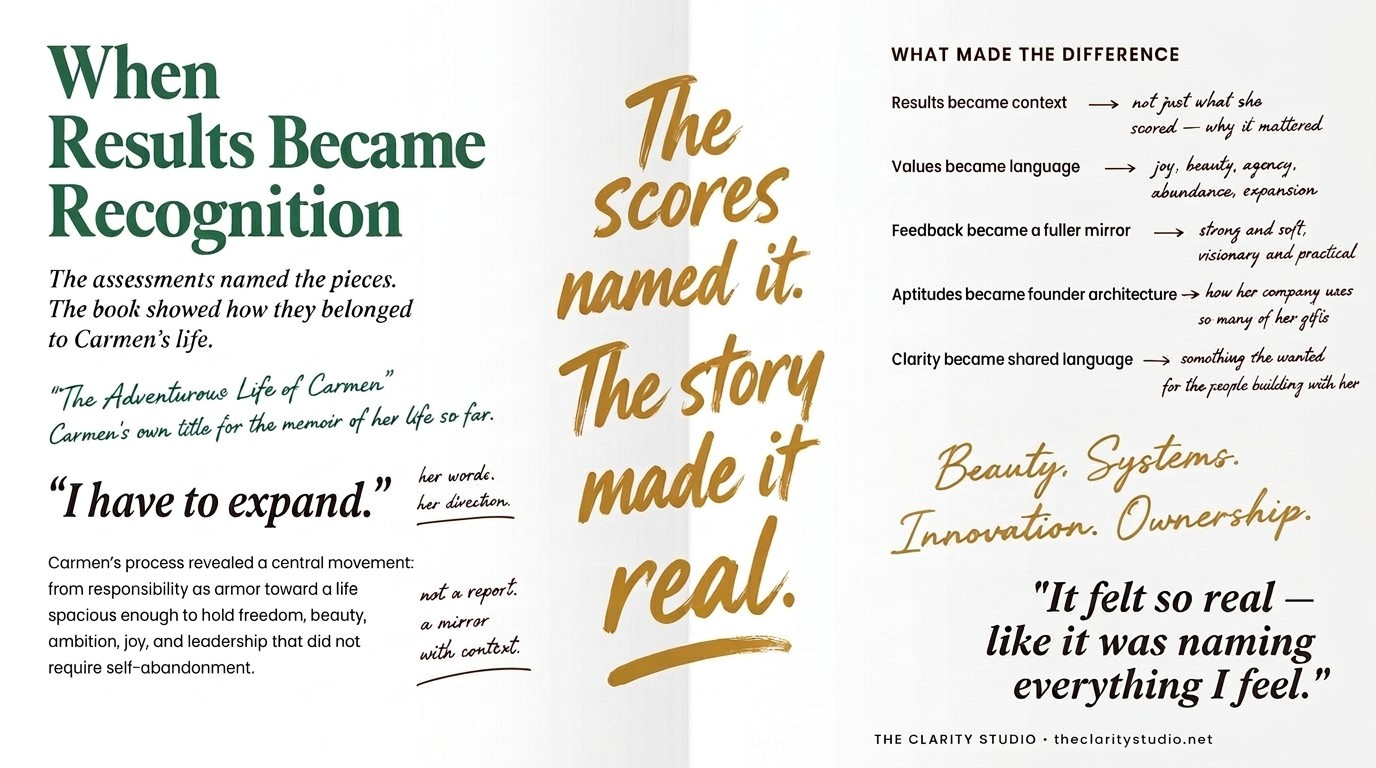
Inspired by the two-page reflections I create for every book I read, this spread is a visual distillation of the client’s story—their full Clarity experience is captured in a personalized book and Individual Growth Plan.
Carmen came to The Clarity Studio as a founder already deep inside the work of building.
She was leading, creating, carrying vision, solving problems, setting standards, supporting people, and shaping a company around work that mattered to her. But the question underneath Carmen’s process was never only about the business.
It was about the woman building it.
Through the Becoming You methodology and The Clarity Studio’s narrative interpretation process, Carmen received structured insight into her values, motivations, feedback, aptitudes, traits, and possible pathways. But what made the experience meaningful was not the data alone. It was seeing those results placed inside the actual context of her life.
That distinction mattered.
A score can name a pattern. A category can offer useful language. A profile can point toward a tendency. But Carmen’s clarity came when those pieces were interpreted through her own words, choices, fears, responsibilities, relationships, leadership, and lived experience.
The assessments named the pieces.
The book showed how they belonged to her.
Why did joy matter so much? Why did beauty feel like emotional order? Why did freedom feel essential? Why did achievement mean becoming, not just succeeding? Why did certain results need nuance rather than surface-level interpretation?
For Carmen, this was the difference between receiving information and being recognized.
A value result that could have sounded like “you don’t care about helping others” became something more accurate: Carmen could care deeply without organizing her life around self-sacrifice. An Enneagram score that could have been read rigidly became a more personal truth: Carmen was an adventurer-builder — someone who longs for freedom, possibility, and expansion, but who also knows how to build, execute, and make the vision real.
The book did not give Carmen a new identity.
It gave language to the one already there.
Again and again, Carmen’s story returned to one central truth:
I have to expand.
That expansion was not restlessness for its own sake. It was a longing for a life with more room — room for joy, beauty, love, adventure, meaningful work, financial freedom, and leadership that did not require self-abandonment.
As the book came together, Carmen began to see that founder clarity and personal clarity were not separate. The same gifts shaping her life were also shaping the company she was building: beauty, systems, innovation, ownership, freedom, and joy. Her business was one garden where many of her gifts were growing. But it was not the whole landscape of her life.
That distinction became one of the book’s central recognitions:
You are not the garden.
You are the gardener.
After reading her book — marked with highlights, notes, and reactions — Carmen described the experience as almost too real, as though it was naming everything she felt. That was the point of the work: not exposure, not flattery, not a set of generic strengths, but recognition with context.
The result was language Carmen could use to understand herself more clearly, lead with more consciousness, and see the people around her with more grace. It was not simply, you took the test. It was, you have a book. A personalized account of what the results mean inside a real life. A mirror with context. A story that turns insight into something a person can actually recognize, carry, and use.